
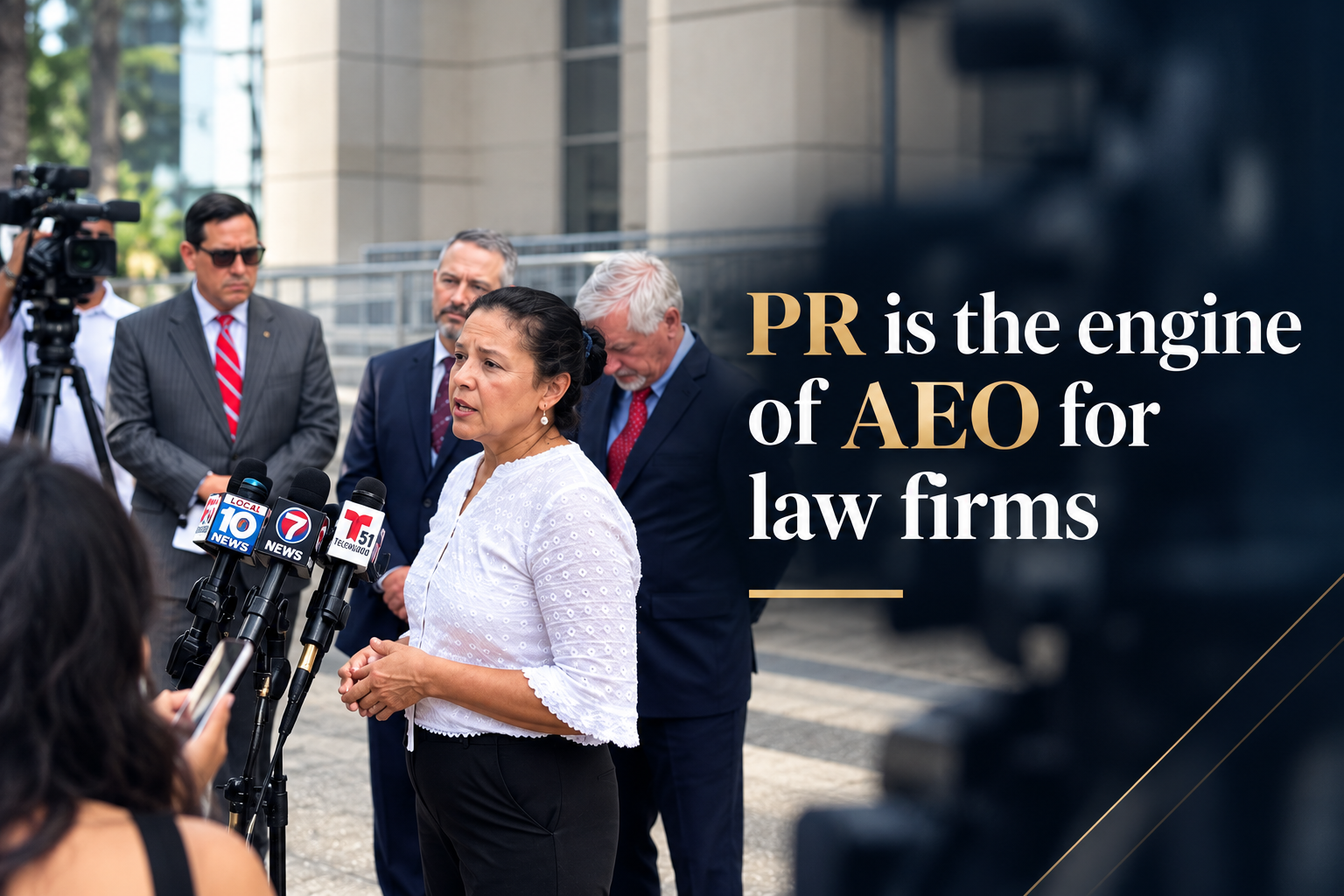
When a general counsel asks an AI assistant to name the strongest commercial litigation firms in a market, the answer does not come from the firm's own website. It comes from what the rest of the internet says about the firm. That makes public relations the single most important lever in answer engine optimization for law firms.
Firms that treat PR as a reputation nice-to-have are about to discover that it has become a discovery channel. The firms named in AI answers are the firms that credible third parties have already named.
What is answer engine optimization for law firms?
Answer engine optimization (AEO) is the practice of making a firm the source, or the subject, of the answers that AI tools give. Those tools include ChatGPT, Perplexity, Gemini, Claude, and Google AI Overviews.
Traditional SEO competes for a ranked list of links. AEO competes for a sentence. A prospect who asks "Who handles construction defect litigation in Miami?" may receive two or three firm names and nothing else. A firm is either in that sentence or invisible.
Why do AI engines rely on third-party sources over a firm's own website?
AI engines are built to give answers a user can trust, so they weigh independent corroboration heavily. No AI company publishes its exact ranking formula, but the pattern is consistent: a firm describing itself as a leader is a claim; a respected publication describing the firm as a leader is evidence.
These systems learn from, and retrieve from, the open web. That web includes legal trade press, business journals, local news, bar association publications, court reporting, podcast transcripts, and conference coverage. When a firm and its attorneys appear repeatedly across those sources, tied to the same practice areas, AI engines form a confident association between the firm and the problem it solves.
A firm's website still matters. It confirms the details. But it rarely creates the association on its own.
How does earned media influence what AI says about a firm?
Earned media shapes AI answers in four ways.
- Entity association. Every article that names a partner alongside a practice area, such as "employment litigator" or "land use attorney," strengthens the link between that person, the firm, and the topic.
- Authority signals. Coverage in established legal and business outlets carries more weight than mentions on low-quality directories or self-published pages.
- Consistency. When dozens of independent sources describe a firm the same way, AI engines repeat that description with confidence. Mixed or thin coverage produces vague answers, or no answer at all.
- Citable expertise. Bylined articles, expert commentary, and quoted analysis give AI engines specific language to pull from when a user asks a substantive legal question.
What kind of PR actually moves AI visibility?
Volume of press releases does not. Strategic placement does. The PR work that builds AEO strength for law firms shares three traits: it is specific to a practice area, it appears in sources AI engines treat as credible, and it repeats a consistent positioning over time.
In practice, that means:
- Expert commentary on breaking legal and regulatory news, positioning named attorneys as the go-to voice on a defined issue.
- Bylined thought leadership in legal trade publications and regional business journals.
- Case and deal announcements, within the limits of client confidentiality and bar rules, that tie the firm to concrete outcomes.
- Speaking, panel, and podcast appearances that generate transcripts and coverage.
- Awards and rankings from recognized, independent organizations, presented accurately.
- Community and pro bono coverage that reinforces the firm's local presence.
How should law firms measure PR's impact on AEO?
Strategy precedes execution, and measurement comes first. Before a campaign begins, document a baseline: ask the major AI engines the questions a prospective client would ask, and record which firms appear, how each is described, and which sources are cited.
Then track three things over time:
- Inclusion rate: how often the firm appears in answers to priority questions.
- Description accuracy: whether AI engines describe the firm's practice areas, locations, and attorneys correctly.
- Cited sources: which publications AI engines point to, which reveals the outlets worth pursuing next.
AI answers vary from one session to the next and shift as models update, so test on a regular schedule rather than drawing conclusions from a single check.
Does legal PR for AEO need to follow bar advertising rules?
Yes. Communications about a lawyer's services are governed by state bar rules, which in most states are modeled on ABA Model Rules 7.1 through 7.3. Claims must be truthful and not misleading, and some states add specific requirements for advertising, testimonials, and claims of specialization. Earned media is not exempt from that discipline when the firm supplies the content. Every pitch, quote, and announcement should be reviewed with the firm's ethics counsel in mind.
The bottom line for managing partners
The question is no longer whether a firm ranks on page one. The question is whether AI names the firm when a client asks for help. That answer is written by the press, the trade journals, and the communities a firm serves, long before a prospect ever reaches its website.
INGAGE pairs senior PR practitioners with search and AEO strategy for law firms across the United States, with one point of accountability from baseline audit to measurable visibility. Talk with our Legal team about where your firm stands in AI answers today.
Frequently asked questions
What is AEO for law firms?
AEO, or answer engine optimization, is the work of making a law firm appear in the answers that AI tools such as ChatGPT, Perplexity, Gemini, and Google AI Overviews give to legal questions.
Why does PR matter for AEO?
AI engines favor independent, credible sources. Earned media coverage tells those engines what a firm is known for, which makes PR one of the strongest drivers of AI visibility.
Can a law firm improve AI visibility with website changes alone?
Website improvements help AI engines confirm details, but third-party coverage is what typically establishes a firm as a recognized authority on a topic.
How long does it take for PR to affect AI answers?
There is no fixed timeline. It depends on how often AI tools refresh their sources and how consistently the firm earns coverage, which is why ongoing measurement matters.
More in this series