
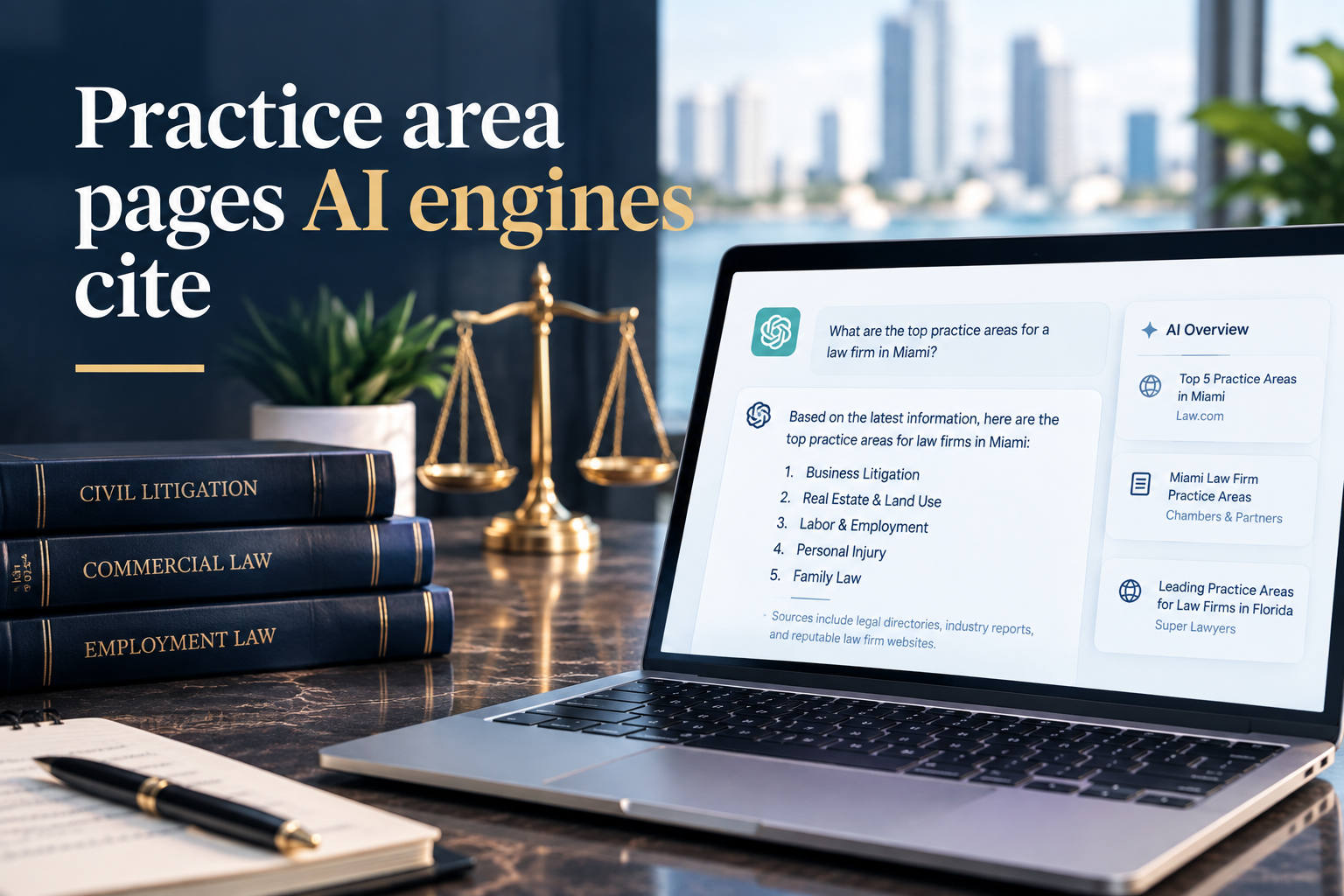
A prospective client does not search for "full-service litigation capabilities." They search for their problem: a contract dispute, a denied permit, a wrongful termination claim. Practice area pages that answer those problems directly are the pages Google ranks and AI engines quote. Pages that list services in the firm's own vocabulary are increasingly skipped.
For most law firms, the practice area pages are the highest-value pages on the site and the most neglected. Rebuilding them is one of the fastest ways to improve both traditional search and AI visibility.
Why do most law firm practice area pages fail in AI search?
They are written about the firm, not for the client. A typical page opens with the firm's history, lists dozens of sub-services in a single paragraph, and closes with a generic call to contact the office.
AI engines look for content that resolves a specific question clearly and credibly. A page that never states a plain answer gives an AI tool nothing to extract. A page that covers 15 practice areas in 300 words gives it nothing authoritative to cite.
What structure helps AI engines understand and quote a practice area page?
The structure that works mirrors how clients actually ask questions.
- Lead with the client's situation. Open with the problem and the stakes in two or three sentences, then state plainly how the firm helps.
- Use question-based headings. Headings such as "What should I do after receiving a notice of violation?" match the phrasing people type into AI tools and search engines.
- Answer first, then explain. Put a direct, self-contained answer in the first one or two sentences under each heading. AI engines often lift exactly that passage.
- Give each practice its own page. One focused page per practice area, and separate pages for meaningful sub-practices, outperforms one long catch-all page.
- Name the people. Link every practice area page to the bios of the attorneys who lead that work.
- Close with a real FAQ. Four to six questions clients genuinely ask, each with a concise answer.
What should each section of a practice area page include?
A strong practice area page covers five elements:
- Who the page is for: the client type, such as business owners, developers, employers, or individuals.
- The problems the firm solves: described in client language, not legal shorthand.
- How the process works: what happens first, what the client should prepare, and what to expect, in plain terms.
- Why this firm: experience, attorney credentials, and representative matters described in compliance with the state's advertising rules.
- Where the firm serves: offices, jurisdictions, and courts, stated consistently with the firm's Google Business Profile and directory listings.
Does schema markup help law firm pages appear in AI answers?
Structured data helps search engines and AI tools interpret a page accurately, though no platform guarantees that markup alone produces a citation. The most relevant types for law firms are LegalService or Attorney for the firm and its offices, Person for each attorney, FAQPage for question-and-answer content, and BreadcrumbList for site structure.
The priority is consistency. The firm's name, addresses, phone number, and practice areas should match exactly across schema, the visible page, and every external listing. Conflicting information is one of the most common reasons AI engines describe a firm incorrectly.
How do bar advertising rules shape practice area content?
They set the boundaries. Most state rules, modeled on ABA Model Rules 7.1 through 7.3, prohibit false or misleading communications about a lawyer's services. Many states also restrict claims of specialization or certification, require disclaimers on past results, and regulate testimonials.
Practical guardrails for practice area pages:
- Avoid words such as "expert" or "specialist" unless the state's rules permit them for that attorney.
- Frame past results with the disclaimers the jurisdiction requires.
- Keep educational content general and avoid language that reads as legal advice to a specific reader.
- Route every page through the firm's ethics review before publishing.
How should a firm measure whether the rebuild worked?
Set the baseline before rewriting a single page. Record current organic rankings for priority practice area terms, organic traffic and contact form conversions by page, and how AI engines answer the questions each page targets.
After the rebuild, compare the same measures on a regular schedule. Expect search rankings to move over weeks or months, and expect AI answers to vary between sessions, so judge results on trends rather than a single snapshot.
The bottom line
Practice area pages are where a firm's expertise either becomes an answer or stays a brochure. Pages that start with the client's problem, answer real questions directly, and connect to named attorneys earn their place in search results and AI answers alike.
INGAGE's Legal specialty group rebuilds law firm content around the questions clients ask, with strategy, compliance, and measurement defined before the first page is written. Contact our team to audit your practice area pages.
Frequently asked questions
How long should a law firm practice area page be?
Long enough to answer the client's core questions completely. Depth and clarity matter more than a word count.
Should every practice area have its own page?
Yes. A dedicated page for each practice area, and for significant sub-practices, gives search engines and AI tools a clear, focused source to cite.
What schema should a law firm website use?
Common choices include LegalService or Attorney, Person for attorney bios, FAQPage, and BreadcrumbList. Confirm current guidance in Google's Search Central documentation and at Schema.org before implementing.
Can practice area pages include past case results?
Often yes, but many states require specific disclaimers or restrict how results are presented. Review the rules in each jurisdiction where the firm practices.
More in this series